domenica 13 aprile 2008

Immigration

Immigration is a very recent issue in Italy. I don't think it's the same in the USA, that's why our next skype exchange will be very interesting on Tuesday.
There are many aspects I'd like to focus on, for example integration . America has been famous for the "melting pot" system. Today, a buzzword in immigration is "multiculturalism". There are so many books concerning this problem... yes, because immigration is considered a social problem. But these words are meaningless! So even if I've studied all these stuffs in ethnology, sociology and so on, I'm curious to know something about integration in the USA:
- how people live together
- are there any problems connected to immigration?
- do people believe that immigrants steal work opportunites to the natives?
- can immigrants obtain the right to vote? How?
Another interesting aspect I'd like to talk about is the immigration policy adopted by the USA and Italy. Here in Italy immigrants have the right to stay only if they've a job. So immigrants = workers. What about the USA?

Skype exchange

The topic of the last skype exchange has been 'political elections'. We had a great discussion because both in Italy and in the USA we're going to vote.

Our conversation pointed out the differences between the two countries. For example we noteced that in the USA the political campaign is open while in Italy there's no real confrontation. I mean, the American leaders met on TV to talk about their electoral programmes, for example. On the contrary, in Italy, Veltroni and Berlusconi do all their best to avoid a face-to-face confrontation. This is strange, isn't it?
Besides, we talked about the media and the press. We noticed how in America there's more attention towards the families of the candidates than in Italy, where the first ladies stay behind the scenes.
Finally I noticed that we (Italian students) were much more informed about American elections than the American peer was about Italian ones.

As a conlusion I'd like to report my post published in 'blogginenglish1' about my intention to vote or not:

"I’m fed up with politics but I’m going to vote!
Yesterday evening I watched BBC and I felt very embarrassed. There was a reportage on Italian elections. The journalist gave a perfect report of the Italian situation: a farce! He even named the elements of this farce:
-there are always the same politicians: one travels by bus far and wide, the other one thinks to be God … “Per fortuna che Silvio c’è…”
-there is no confrontation between the different fronts but just a tit-for-tat through press releases


I perfectly agree with this journalist. But, in spite of everything I’m going to vote because if you renounce the right of vote, you renounce democracy."

Let me know what do you think...

domenica 6 aprile 2008

... Culture!


photo by @Lupinthethird
Hello everybody!

This week I started to think about my final project. I have to choose a topic concerning an aspect of American culture to be compared with the Italian one. But... what is culture?!? Fortunately, last semester we have already discussed about it; culture involves everything: food, religion, habits, music, language, values. That's why it's quite hard for me to choose a topic because I'm interested in a lot of things.

By the way, the most curious aspect I'd like to focus on is the educational system. Before starting the skype exchange, I decided to visit Dickinson site. Here you are the link www.dickinson.edu/ . I was really impressed because it's quite different from our university and the idea of university I have. This different organisation has many consequences, the most important one is the following: American students have the opportunity to experience University life. (I think, for example, at my American peer Kristen: she's from California and she moved to study there...)
In my final project I'd like to make some comparisons between Italian and American universities. Maybe it's a banal topic but there are many reflections I can do which involves not only the educational system, but life in general.

domenica 30 marzo 2008

Yoga

photo by myyogaonline
I chose this picture because YOGA reminds me the practice of meditation. It’s an interesting association, isn’t it?

YOGA stands for Your Objectives, Guidelines, and Assessment form and it’s a self-evaluation test on cross cultural preparation. We all should be experts because we’ve just finished “Mediazione Linguistica and Culturale”… actually we’re not! … (I don’t want to be polemical so…dot dot dot!)

I think that if you want to be able to deal effectively with differences, you should have some intercultural competencies. For example you should be proficient in the second language and in the culture involved. But this is not enough because it’s only theory! I think that people should have some important intercultural educational experiences. In my opinion this is a shortcoming of the Italian educational system in general.
In five years of university the skype exchange has been the only intercultural project I’ve experienced – this is not enough if your declared objective is to prepare intercultural experts.

The test consists of 5 different parts: awareness, attitude, skills, knowledge and language proficiency.
I found quite simple to self-evaluate in the sections knowledge and language proficiency, maybe because they’re the most objective ones and because I’m aware of what I know and I’m able to do. I mean, it’s not new for me to self-evaluate my language proficiency or my knowledge of another culture because I’ve done similar activities, such as the European Language Portfolio and the PLE.
On the other hand, I found harder to self-evaluate my awareness, my attitude and my skills. Most of the questions were aspects I had never considered before. For example how my social identity is perceived by the host culture and within my culture.

Even the distinction of four different levels for each section is very useful:
Educational traveller
Sejourner
Professional
Intercultural/ Multicultural Specialist
I’ve always reached the third level, sometimes the fourth. It’s quite good, isn’t it?!? J

YOGA is a very useful tool because it shows you where your deficiencies are. Once you know your problems you can set your objectives to solve them! That’s the only way to improve. What do you think about it? Let me know…

venerdì 28 marzo 2008

Skype exchange

The week before the Easter break I started my Skype experience and I really enjoyed it. Federico introduced me to this new world; it was the first time for me and I looked for a little help because I felt lost! Actually, Skype is a quite simple tool and I had no problems in understanding how it worked.
Our peer is a student from California with Chinese origins. For about 40 minutes we talked in English and then we switched to Italian.
The topic of this week was terrorism. We talked about it in English but in Italian it was quite impossible. Her Italian is quite good considering she has been studying it for a year but the topic was too difficult for her… That’s why Federico and me decided to ask her some personal questions in order to make her feel at ease. We talked about her experiences in Europe and her next trip to Italy in spring: she’s coming to Italy on holiday ( a cruise) and then she’s staying in Bologna to study. Federico helped her writing the words she didn’t understand and that’s how we managed to chat!

I LOVE SKYPING!
Stefania

domenica 23 marzo 2008

HAPPY EASTER!!!

photo by dearbarbz366
EASTER BUNNY

EASTER BUNNY

SMALL AND WHITE

COME AND FILL MY BASKEY

OVERNIGHT

domenica 9 marzo 2008

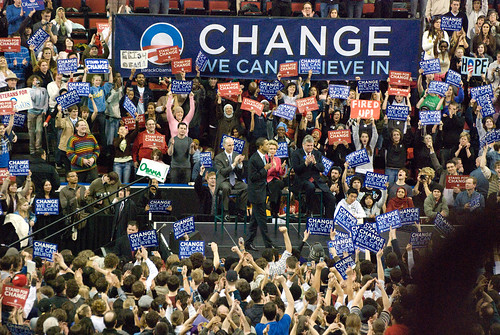
US ELECTIONS - OBAMA


photo by Scott Butner

hi everybody!

Since I wasn't in contact with you, I've just decided to do my task about Obama. Let me know if you want me to change...


I watched several videos about Obama in YouTube and I identified some key words and key expressions.
The most important word in Obama’s campaign is “change”. He always says “yes, we can”. At the end of his speeches he proclaims: “we say, we hope, we believe: yes, we can”.
This political slogan is very recurring and has a great impact on the audience because of the pronoun “we”. “We” means: you and me, Obama; like a sort of political agreement between a politician and common people. Obama always refers directly to his audience: “I’ve spoken with you”; “many of you shares with me”; “I believe in you”; “we want a new course for this country”. The slogan “yes we can” becomes a concrete concept in his speeches: he says he wants to change politics. But again he proclaims “it comes from you”. Thanks to these expressions he makes people feel involved in the building of a new country based on a new concept of politics.


Even if he seems quite calm, he knows how to be ironic and polemic. For example he has a very intransigent attitude towards the war in Irak. I think he is very clever and he knows how to provoke people’s reactions. He has a sort of double attitude: he is kind and well educated but at the same time he is very intransigent and firm.


Finally, I'd like to point out the informality of his attitude towards the audience. The implicit message is: if you want to change politics, choose me because I am a common man like you.


Surfing the net I watched some videos against Obama... it would be interesting to do a crossed analysis using all the materials - pros and against.


Stefania!